
I am going to say something that might sound like a complaint but is in fact a compliment: Samburu National Reserve is deeply weird. Not in a bad way. In the way that certain places are when they have evolved in isolation and produced things that exist nowhere else – a Galapagos quality, an ecological specificity that keeps surprising you just when you think you have taken its measure.
I arrived by road from Nanyuki, a three-hour drive north from Mount Kenya that took us out of highland green and into something increasingly dry and austere. The landscape changed in layers: first the orderly farms of the foothills, then open grassland, then thorn scrub, then, as we dropped towards the Ewaso Ng’iro River, a semi-arid country of red soil, doum palms, and termite mounds the height of a man. The air was drier, the light harder, the vegetation sparser. By the time we reached the gate to the reserve, I had a proper sense of being north – of being properly remote in a way that even the Mara, with its organised lodge infrastructure, doesn’t quite manage.
The Ewaso Ng’iro River
The Ewaso Ng’iro River is the spine of Samburu. It runs through the reserve in a wide, sandy-banked course and every animal that lives in this dry country needs it. The banks are lined with riverine forest – acacia, tamarind, doum palm – that provides shade and cover. All the game drives I did were structured to varying degrees around the logic of the river. Where there was water, there was everything else.
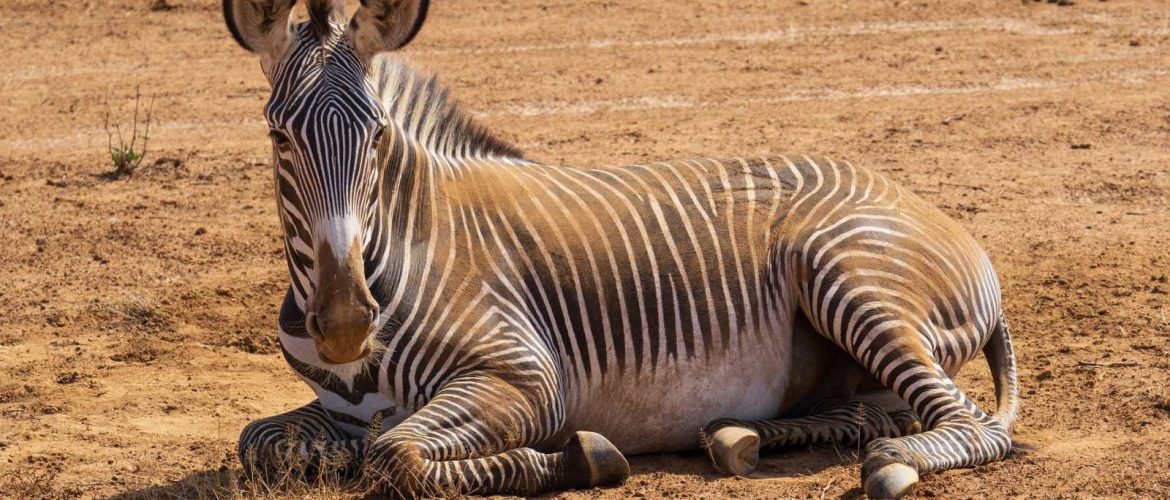
But it is the Special Five that make Samburu famous and, rightly so. These are five species found here that can’t be seen in the more southern parks: the reticulated giraffe, the Grevy’s zebra, the Beisa oryx, the Somali ostrich and the gerenuk. The Grevy’s Zebra Trust works extensively in Samburu, where the world’s largest remaining Grevy’s zebra population lives – fewer than 3,000 animals, making every sighting a meaningful one.
The Special Five
The reticulated giraffe was the one that stopped me first. Giraffes are giraffes everywhere – spectacularly improbable, impossible not to love – but the reticulated subspecies has a markedly different coat pattern from the Maasai giraffe of the south: bold, clearly defined patches of deep orange-brown separated by crisp white lines, almost like an art deco pattern. Standing in a group of five against the doum palms at the edge of the river, they looked designed rather than evolved. I stared at them for a long time trying to reconcile the familiarity of the shape with the strangeness of the colouring.
The gerenuk is smaller, but more bizarre. It is a medium-sized antelope with an improbably long neck and slender legs, and its key anatomical party trick is the ability to stand upright on its hind legs to reach leaves on high branches. I spent twenty minutes watching a female gerenuk, balanced perfectly vertical, reaching into an acacia with her front hooves and eating with complete unhurried concentration. She was in the truest sense extraordinary to look at. I kept thinking of the word “improbable” and then changing it up to the next level.
The Grevy’s zebra is the largest of the zebra species and the most endangered. Its markings are distinctly different from the common plains zebra – the stripes are narrower, more closely spaced, almost fine-lined, and the belly is white without stripes. Save the Elephants is based in Samburu and has been monitoring elephant movements in the reserve for decades. My guide Lesuuda knew several of the researched elephants personally, and listening to him talk about individual animals and their histories gave the game drives a depth that straightforward wildlife viewing does not always have.
The Samburu People and Cultural Context
My guide in Samburu, a man of the Samburu people themselves named Lesuuda, added a whole new dimension to the experience. The Samburu are a Nilotic people, related to but different from the Maasai, and Lesuuda had grown up in a community next to the reserve. His knowledge of the ecosystem was biological and cultural simultaneously – he explained which plants were used medicinally, pointed out landmarks that had spiritual significance, and talked about the reserve’s wildlife in terms of his community’s long relationship with these animals rather than in the more clinical wildlife management terms I was used to hearing.
He took me one afternoon to meet his uncle, a senior elder in a nearby manyatta – the traditional Samburu homestead – who showed me how to start a fire with two sticks and some dried dung, and who then talked, through Lesuuda’s translation, about how the landscape had changed over the decades of his long life. Less rain. Different animal patterns. The river running lower and lower every year. He spoke without drama or visible distress, stating facts, but the facts themselves were distressing, and they gave context to everything I was seeing in the park.
Nights in Samburu
The nights in Samburu are spectacular in the astronomical sense. The reserve is sufficiently far north that there is little light pollution, and the dry air and altitude create the kind of star density that sends even moderately jaded travellers straight for their cameras. I spent one whole evening after dinner lying on a camp stretcher in the middle of the lodge compound, looking up, trying to find constellations I recognised and mostly failing because there were simply too many stars interfering with the pattern.
Samburu does not feature as prominently in travel writing as the Mara or Amboseli, and I think this is partly because its character is harder to summarise. It is not the drama of the migration. It is not the background of Kilimanjaro. It is something quieter and stranger and more specific – a particular landscape with particular animals and a particular community of people whose relationship with this place goes back further than the park’s formal existence.
If you have been to the southern parks and want to dig deeper into the variety of Kenya, go north. Go to Samburu. Find a guide who grew up there. Let the strangeness of the gerenuk recalibrate what you think is possible.